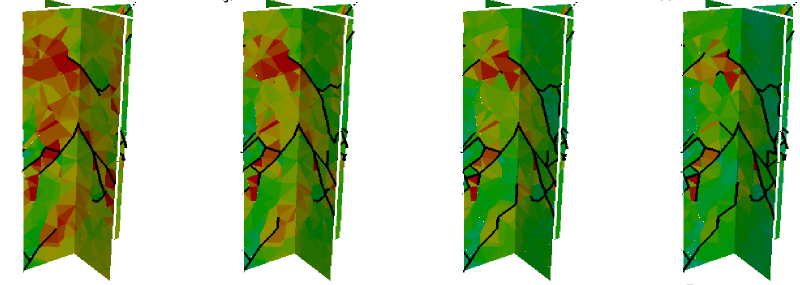

We are excited to announce that we have been working on the introduction of hydro-mechanical (H-M) coupling in our Irazu FDEM software. The introduction of H-M coupling arguably makes the Irazu software one of the most sophisticated simulation software currently available for geomechanical applications as a multitude of multi-physics processes can be taken into account, … Read more
FEMDEM
Geomechanica is launching a guest blog series, written by experts and numerical modellers in the field of rock engineering. In the first post of this series, we’re showcasing the work of Andrés Alcolea on “A pragmatic methodology to abstract the EDZ around tunnels of a geological radioactive waste repository – Application to the HG-A experiment … Read more
The ability to capture increasingly complex behaviours within a numerical simulation is typically accompanied by an increase in the number of input parameters that must be specified. Inevitably, with additional physics come additional parameters to govern these physics. Critics of numerical modelling often cite the uncertainty associated with parameter selection as a reason to avoid … Read more
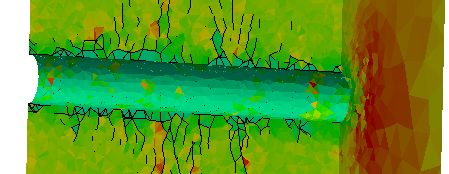
Following up from our previous blog post on 3D FEMDEM Simulations, 3D simulations of a tunnel excavated in a weak rock (resembling properties of a clay shale) are presented here (E=3.8 GPa, ν=0.25, σt=0.41 MPa, c=5 MPa). In this simplified case study, the entire length of the tunnel was excavated at once at the beginning … Read more
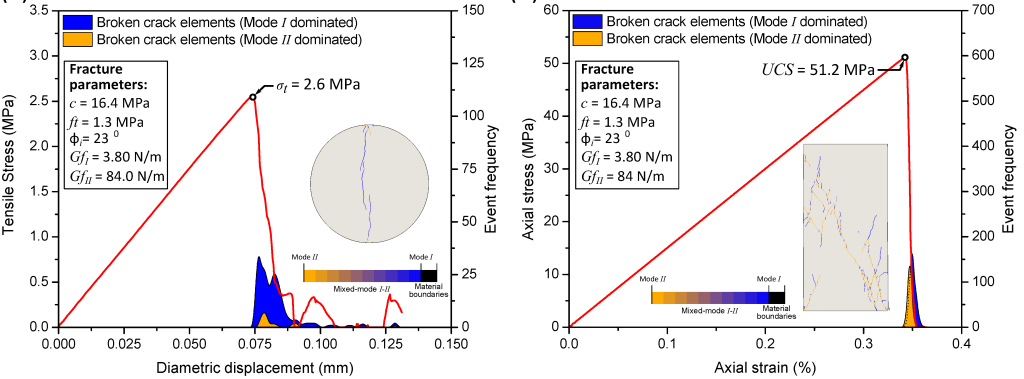
We have been working on a prototype of three-dimensional FDEM. We’ve implemented most of the critical features into the code, including a quasi-static friction law, Mohr-Coulomb failure criterion, and transversely isotropic elastic constitutive law. We’re excited to showcase some of the simulations results here. The figure below shows the simulation of a uniaxial compression test … Read more