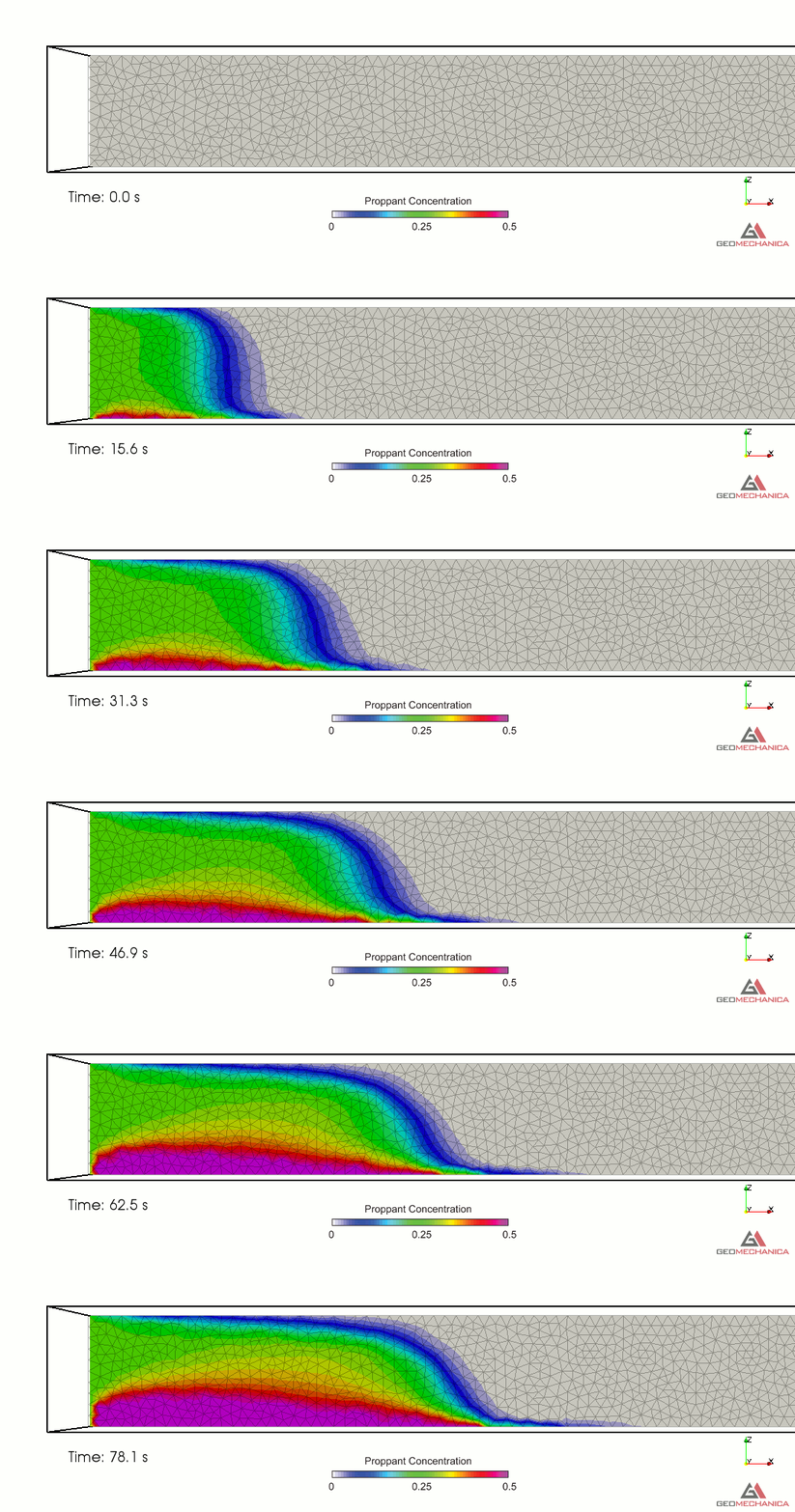
During hydraulic fracturing treatments from horizontal wells, proppant slurries are pumped into the induced fractures to prevent crack closure upon de-pressurization, thus enhancing hydrocarbon recovery. Transport and emplacement of proppant particles may have a strong influence on the rock mass stress re-distribution and hydraulic conductivity of the induced fracture network. Therefore, prediction of proppant injection … Read more
Irazu
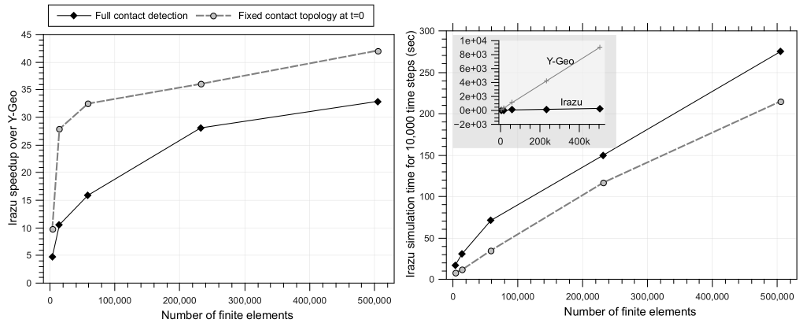
Irazu makes use of state-of-the-art high performance computing techniques to speed-up computations. In particular, we use GPU (graphics processing unit) computing on consumer-grade AMD graphics cards. To demonstrate the improvement in computation speed, five uniaxial compression strength (UCS) tests with an increasing number of finite elements were simulated using Irazu and the sequential CPU code … Read more
We are excited to announce that we have been working on the introduction of hydro-mechanical (H-M) coupling in our Irazu FDEM software. The introduction of H-M coupling arguably makes the Irazu software one of the most sophisticated simulation software currently available for geomechanical applications as a multitude of multi-physics processes can be taken into account, … Read more
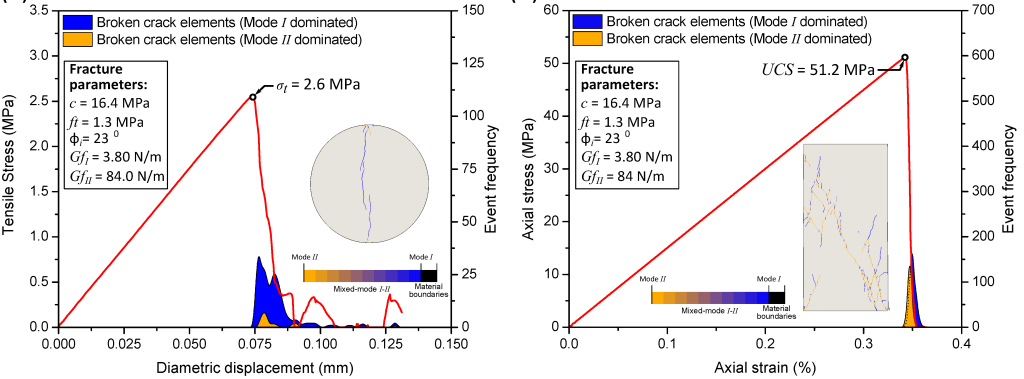
The ability to capture increasingly complex behaviours within a numerical simulation is typically accompanied by an increase in the number of input parameters that must be specified. Inevitably, with additional physics come additional parameters to govern these physics. Critics of numerical modelling often cite the uncertainty associated with parameter selection as a reason to avoid … Read more
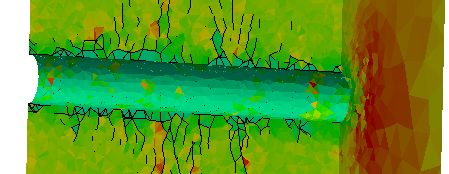
Following up from our previous blog post on 3D FEMDEM Simulations, 3D simulations of a tunnel excavated in a weak rock (resembling properties of a clay shale) are presented here (E=3.8 GPa, ν=0.25, σt=0.41 MPa, c=5 MPa). In this simplified case study, the entire length of the tunnel was excavated at once at the beginning … Read more